Sealed Against Water, Dust, and Mud
IP68 means the phone can sit submerged in fresh water without failing. IP69K goes further and adds high-pressure, high-temperature spray — the kind of thing that happens when you rinse concrete dust off a device at the end of a shift. Port covers, gasketed seams, and a bonded display do the work, not a case you can forget to snap shut.
Drop-Tested to Military Standards
MIL-STD-810H is a testing methodology, not a warranty, but phones built to it are put through repeated drops onto plywood over concrete, vibration cycles, humidity, salt fog, and temperature extremes. Reinforced corners, a metal inner frame, and a raised bezel around the glass are what keep a fall from ending your day.
Batteries That Outlast the Workday
Where a typical phone carries around 5,000 mAh, rugged models routinely ship with 10,000 mAh and up, and a few push far past that. Two-day runtime is normal. Many also offer reverse charging, so the phone doubles as a power bank for a headlamp, a GPS unit, or a coworker’s dying handset.
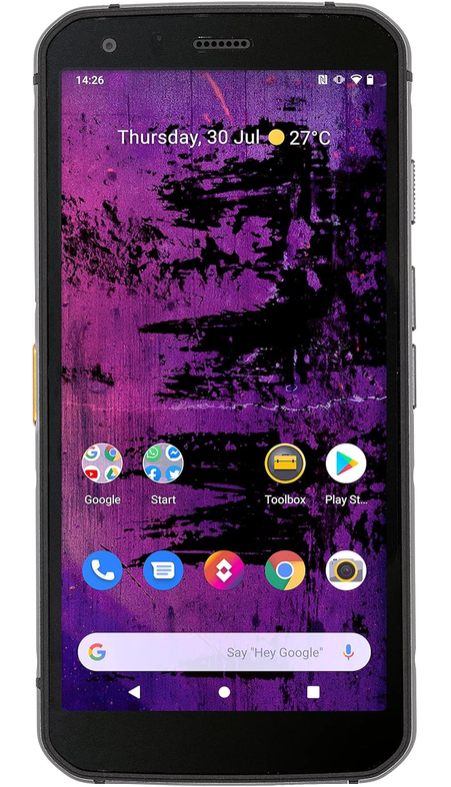
Cat S62 Pro Rugged unlocked 6GB Smartphone – North America Variant – with FLIR Thermal Imager – Full Warranty Support in US and Canada
| Brand | CAT |
| Operating System | Android 10.0 |
| Ram Memory Installed Size | 6 GB |
| CPU Model | A-Series |
| CPU Speed | 2 GHz |
| Memory Storage Capacity | 6 GB |
| Screen Size | 5.7 inches |
| Resolution | 1280 x 720 |
| Model Name | CS62PDBBRONUN |
| Wireless Carrier | Unlocked |
What Actually Makes a Phone Rugged
The word “rugged” gets used loosely. Plenty of mainstream phones now carry a water-resistance rating and call it a day. A true rugged phone is engineered differently from the frame outward: a die-cast metal or reinforced polymer chassis, overmolded rubber on the corners where impact energy concentrates, a display recessed below the bezel line so it never lands face-flat, and screwed-down gaskets sealing every seam. Ports are either capped with rubber plugs or replaced entirely by magnetic pogo-pin charging.
That construction has a cost, and it’s honest to name it. Rugged phones are thicker and heavier — often 300 to 400 grams versus roughly 200 for a slim flagship. They rarely lead on camera quality or software update timelines. What you get in exchange is a device that survives conditions that would retire an ordinary phone in a week.
Reading the Ratings Without Getting Fooled
IP ratings use two digits. The first covers solids: 6 is the maximum and means fully dust-tight. The second covers liquids: 7 means temporary immersion, 8 means continuous immersion at a depth the manufacturer specifies, and 9K means resistance to close-range, high-pressure, high-temperature water jets. IP68 and IP69K aren’t a ladder — they’re separate tests, which is why serious phones list both.
A few caveats worth knowing. IP testing is done with fresh water in lab conditions, on a new device. Salt water, chlorinated pools, and solvents aren’t covered. Seals age. If a phone has gone swimming, rinsing it in fresh water afterward is genuinely good practice.
MIL-STD-810H is a U.S. Department of Defense test standard covering dozens of environmental methods. Manufacturers choose which methods to run and self-certify the results, so the phrase alone tells you less than it seems to. What matters is the specific claim: drop height, number of drops, and operating temperature range. A phone rated to work from -20°C to 60°C is telling you something concrete.
The Features Worth Paying For
Battery capacity is the single most transformative spec on a rugged phone. If you’re away from outlets — surveying, camping, driving long routes, working a site with no reliable power — a 10,000 mAh-plus cell changes how you plan your day. Check the charging wattage too, because a huge battery paired with slow charging means an overnight refill.
Screen brightness and glove touch. Outdoor readability depends on peak nits, not resolution. Anything under about 500 nits will wash out in direct sun. Glove mode and wet-touch mode raise touchscreen sensitivity so the display still responds through work gloves or with rain on the glass — small features that matter enormously in practice.
Programmable keys and push-to-talk. A dedicated physical button that launches a flashlight, a camera, an SOS message, or a PTT channel is far more usable than an on-screen shortcut when your hands are occupied or gloved.
Specialty sensors. Higher-end models add genuinely useful instruments: thermal imaging cameras for spotting heat loss in insulation or a failing electrical connection, infrared night vision for wildlife and low-light inspection, laser rangefinders, and even built-in projectors. These raise the price substantially, so buy them only if the job calls for them.
Connectivity. 5G, NFC for tap payments, dual SIM, an unlocked GSM radio, and microSD expansion are all common but not universal. Verify band support against your carrier before ordering — this is the most frequent source of buyer’s remorse in this category.
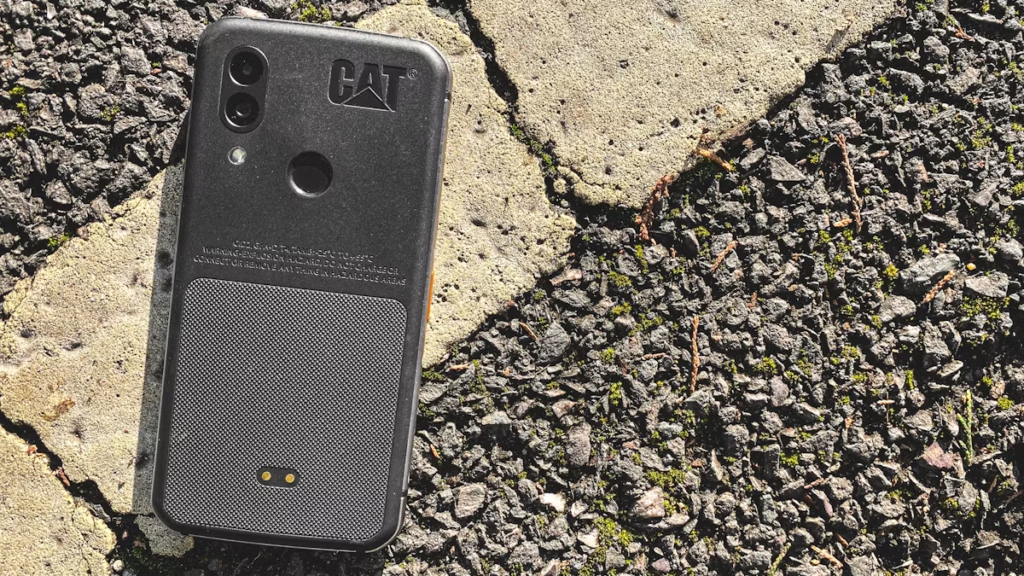
If you’re looking for a durable phone built to handle demanding environments, the Cat S62 Pro Rugged Smartphone is worth considering.
Matching the Phone to the Job
Three rough profiles cover most buyers.
Trades and field service. Prioritize IP69K, glove touch, high screen brightness, and a programmable key. Thermal imaging pays for itself quickly in HVAC, electrical, and building inspection work.
Outdoors and travel. Prioritize battery capacity, GPS accuracy, a bright flashlight, and weight — the heaviest models are punishing on a long hike. Reverse charging is a quiet standout when you’re days from a wall socket.
Everyday durability. If you simply break phones, the newer slim rugged models are the answer. They carry the certifications without the brick shape and behave like a normal phone the rest of the time.
Before You Order
Confirm the Android version and how long the manufacturer supports updates — this is where budget rugged phones cut corners hardest. Check the actual weight and thickness against something you own, because spec sheets don’t convey heft. Verify carrier bands. And decide honestly whether you need thermal imaging or you just think it looks impressive, because it’s usually the difference between a mid-range and a premium price.
A Rugged Smartphone Is Not the Same as a Phone in a Tough Case
The most common shortcut buyers try is wrapping a mainstream handset in armor and calling it protected. It isn’t the same thing. A rugged smartphone is sealed at the factory, with gaskets compressed between the frame and the display, adhesive-bonded glass, and port covers designed as part of the chassis. A case sits on the outside of a device that was never sealed to begin with, and every charging cycle means popping it open again. When a rugged smartphone goes into a puddle, the seals are already closed. When a cased phone goes into a puddle, the outcome depends on whether you remembered to shut a flap that was never engineered to be watertight.
There’s a structural difference as well. In a rugged smartphone, impact energy travels through a metal inner frame and dissipates into rubber overmolding at the corners. In a cased phone, that energy still reaches a chassis designed for thinness. This is why a rugged smartphone survives repeated falls onto concrete while a cased flagship often survives the first three and fails on the fourth.
Rugged Smartphone Battery Life in Real Conditions
Spec sheets describe a rugged smartphone battery in ideal conditions. Cold weather is where the difference shows. Lithium cells lose usable capacity below freezing, which is why a rugged smartphone rated to operate at -20°C matters more to a winter field crew than raw milliamp-hours do. A 10,000 mAh rugged smartphone at -10°C will still comfortably outlast a 5,000 mAh flagship that has already shut down.
Charging deserves equal attention. A large-capacity rugged smartphone paired with an 18W charger can need four hours or more to fill. Faster-charging models cut that dramatically, and some rugged smartphone lines support magnetic pogo-pin docks, which is a genuine convenience because it avoids opening the rubber USB-C cover several times a day. Every time that cover is opened and reseated, the seal wears slightly. A rugged smartphone that charges on a dock keeps its waterproofing intact far longer.
Reverse charging is the underrated feature here. A rugged smartphone with a very large cell doubles as a power bank for a headlamp, a GPS handheld, a two-way radio, or a coworker’s dead phone — which quietly removes an item from your pack.
What to Expect From a Rugged Smartphone Camera
Be realistic. A rugged smartphone rarely competes with a photography flagship, because the sealed housing constrains lens stack height and thermal headroom, and because engineering budget goes into durability instead. Main sensors on a good rugged smartphone are perfectly capable of documentation work — site photos, damage records, serial plates, inventory shots — and that’s what most buyers actually need.
Where a rugged smartphone can genuinely outperform a mainstream phone is in specialty imaging. Infrared night vision captures usable images in complete darkness, which no standard phone camera can do. Thermal sensors turn a rugged smartphone into a diagnostic instrument for insulation gaps, overheating connections, and hydronic heating faults. If your work involves either of those tasks, the right rugged smartphone replaces a separate tool you’d otherwise carry.
Keeping a Rugged Smartphone Sealed Over Time
Waterproofing is a maintenance item, not a permanent property. A few habits extend the life of any rugged smartphone:
- Rinse the device in fresh water after exposure to salt, mud, concrete slurry, or chemicals, then dry it fully before opening any covers.
- Inspect the rubber port flaps periodically. Grit trapped in a gasket is the single most common reason a rugged smartphone starts letting water in.
- Keep the speaker and microphone mesh clear. Dried mud muffles audio long before it affects the seal.
- Avoid hot-water immersion. IP ratings on a rugged smartphone are established with cool fresh water, and heat expands seals in ways the test never covered.
- Don’t open port covers while the device is wet — that’s how water reaches the inside of an otherwise perfectly sealed rugged smartphone.
Mistakes People Make When Buying a Rugged Smartphone
Buying on toughness alone. Every rugged smartphone in the category is tough. The differences that determine satisfaction are screen brightness, charging speed, band support, and weight.
Ignoring carrier bands. This is the most frequent regret with an unlocked rugged smartphone. Confirm LTE and 5G band compatibility with your carrier before ordering, especially for models sold across multiple regions.
Overbuying sensors. Thermal imaging is superb when the job calls for it and dead weight when it doesn’t. Choose a rugged smartphone around the work you actually do.
Underestimating weight. A 400-gram rugged smartphone feels different in a shirt pocket than a 200-gram flagship does. If you hike, that difference compounds over a day.
Skipping the software question. Update policy is where budget models cut hardest. Check what Android version a rugged smartphone ships with and what the manufacturer commits to.
Choosing Your Rugged Smartphone
Start from the environment, not the spec sheet. Pressure-washing and chemical exposure point to an IP69K-certified rugged smartphone. Long shifts away from power point to maximum battery capacity. Bright sun points to peak display brightness. Gloves point to a rugged smartphone with a dedicated glove mode and a programmable physical key.
Match those requirements first, then compare the models that clear the bar. Chosen that way, a rugged smartphone stops being a compromise and becomes the last phone you’ll need to replace for a long while.
What does IP68 mean on a rugged phone?
The 6 means the enclosure is completely dust-tight. The 8 means it can be submerged continuously in fresh water to a depth the manufacturer specifies — commonly 1.5 to 2 meters for 30 minutes. It doesn’t cover salt water, chlorinated water, or high-pressure jets.
What’s the difference between IP68 and IP69K?
They test different things. IP68 covers still-water immersion. IP69K covers close-range spray at high pressure and high temperature, which is what happens during a pressure-wash or industrial cleaning. A phone can carry both, and the toughest models do.
Is MIL-STD-810H a guarantee my phone won’t break?
No. It’s a set of environmental test methods, and manufacturers select which ones to run and certify the results themselves. Treat it as a signal of design intent, then look for the specific claims — drop height, number of drops, and operating temperature range — that back it up.
Are rugged smartphones too heavy for everyday use?
The traditional ones are noticeably heavier, often 300 to 400 grams, largely because of the battery. A slimmer class of rugged phone now exists that keeps IP68 and MIL-STD certification at close to normal weight, trading away the enormous battery to get there.
How long do rugged phone batteries last?
Two days of mixed use is typical for a 10,000 mAh model, and light users often stretch it further. Larger cells go longer still. Check charging speed alongside capacity — a big battery with a slow charger can take several hours to refill.
Can I use a rugged phone with gloves on?
Most support a glove mode that increases touchscreen sensitivity. Many add a wet-touch or water-lock mode that keeps the screen usable in rain and prevents phantom taps from water droplets. Both are settings you enable, not always-on defaults.
Do rugged phones run standard Android apps?
Yes. They run Android with access to the Google Play Store, so your usual apps work normally. Update cadence varies widely by brand, so check the manufacturer’s support commitment if long-term software matters to you.
Is thermal imaging on a phone actually useful?
For the right work, very. It reveals heat loss around windows and insulation, overheating breakers and connections, and blockages in radiant floor heating. Resolution matters — higher sensor resolution means you can identify smaller problems from further away. For general use, it’s a premium you can skip.
Will an unlocked rugged phone work with my carrier?
Usually on GSM networks, but band support varies by model and region, and some carriers require devices to be on an approved list. Check the phone’s supported LTE and 5G bands against your carrier’s before ordering — this is the most common compatibility issue in this category.
Can I take a rugged phone in the ocean?
IP ratings are established with fresh water. Salt is corrosive to seals and connectors, so ocean use is at your own risk. If it happens, rinse the phone in fresh water and dry it thoroughly before opening any port covers.